Let me guess your evening routine. Dinner. Couch. Phone. Scroll. Scroll. Scroll. An hour disappears. You feel worse than when you sat down. You go to bed with a vague sense that you wasted your time, and you do the exact same thing tomorrow.
I am not judging. I did it too. Everyone does.
According to data from eMarketer, the average US adult spent 4 hours and 39 minutes on their phone per day in 2024. That is 32.5 hours per week. Over a year, that is 70 full days spent staring at a screen in your hand. Not working. Not creating. Consuming.
And here is the thing that never makes the headlines: most people know this. They feel it. That low-grade guilt after an hour of scrolling. The sense that you could have done something, been something, made something with that time. But the pull of the phone is stronger than the pull of the alternative, because most alternatives require more activation energy than swiping.
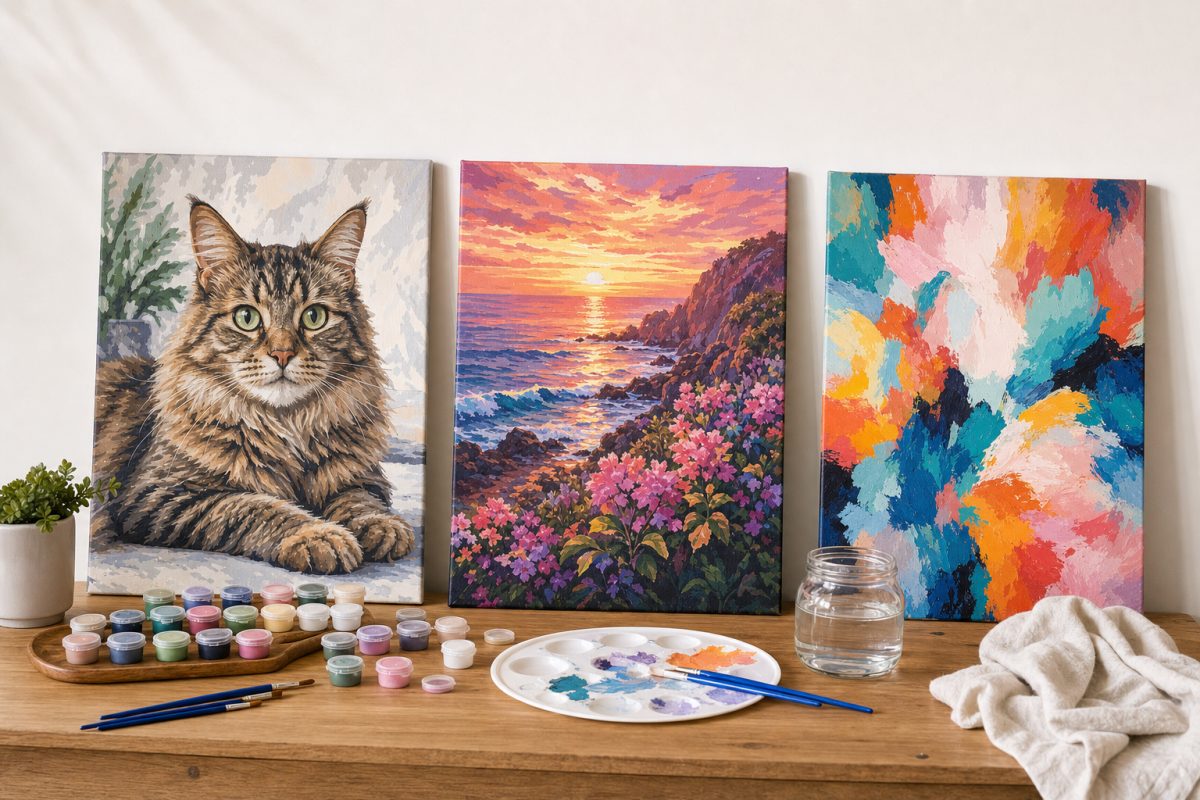
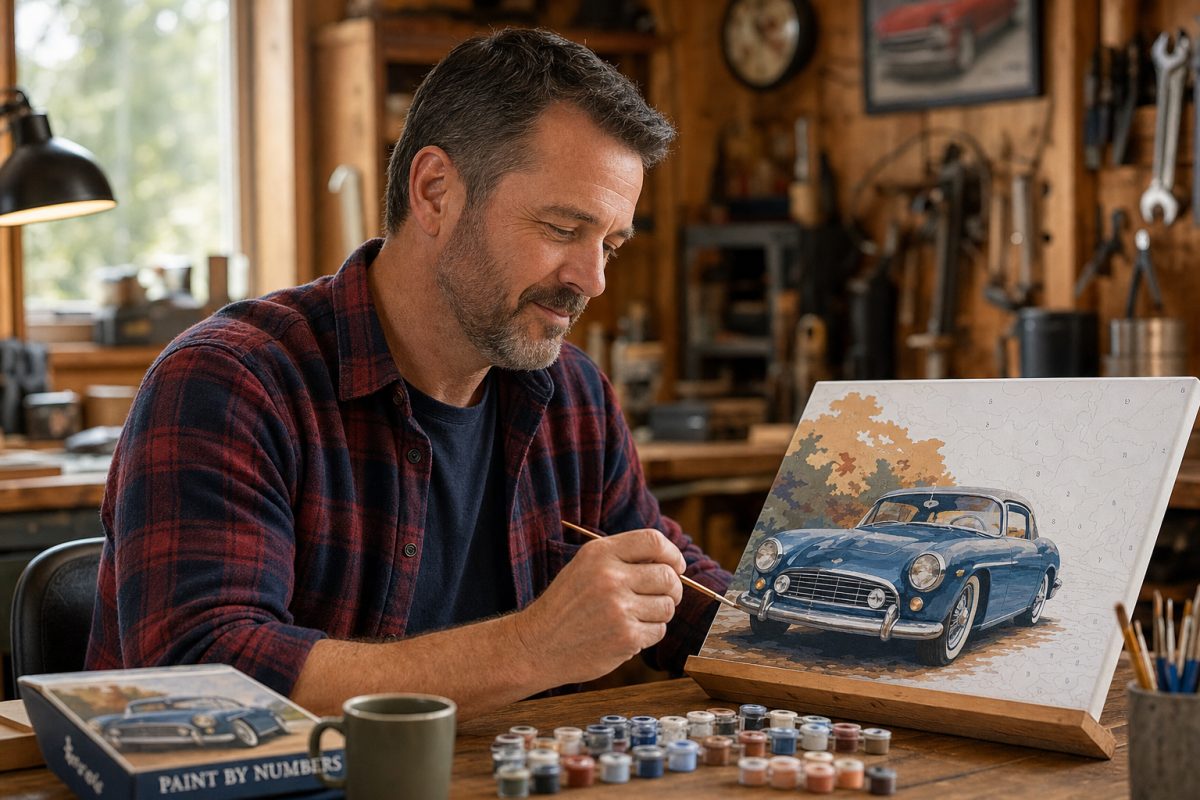
But something is shifting. A growing number of adults are quietly replacing that scroll session with something older, slower, and surprisingly effective at shutting the noise off. They are picking up a paintbrush.
Not because they are artists. Because they are tired.
Your Brain on Scrolling vs. Your Brain on Painting
When you scroll your phone, your brain is in what neuroscientists call a state of "continuous partial attention." You are half-reading, half-watching, half-processing, fully resting in none of it. Your dopamine system is getting tiny hits from each new piece of content, just enough to keep you swiping but never enough to produce actual satisfaction. It is the neurological equivalent of eating chips: each one promises the next will be the satisfying one, and it never is.
Research from the University of California, Irvine, found that people who were interrupted (or who interrupted themselves with phone checks) during focused work needed an average of 23 minutes and 15 seconds to return to the original task at the same level of concentration. When you scroll, you are not resting your brain. You are fragmenting it.
When you paint, something fundamentally different happens.
Your brain enters a state researchers call "flow." You are focused on one thing: matching this color to this number in this section. Your prefrontal cortex, the part that worries about tomorrow and rehearses conversations you will never have, goes quiet. Your default mode network, the part that replays embarrassing things from 2014 and cycles through your anxieties, takes a break.
What you are left with is the closest thing to meditation most adults will ever experience. And it does not require you to sit still and think about nothing, which, let us be honest, is terrible advice for anyone whose brain does not come with an off switch.
A 2020 study published in Frontiers in Psychology measured cortisol (the primary stress hormone) in participants before and after 45 minutes of creative activity. In 75% of participants, cortisol dropped significantly. The key finding: this effect was independent of artistic skill or experience. Beginners got the same cortisol reduction as experienced artists. The act of creating, not the quality of what was created, drove the result.
The Ritual That Builds Itself
Here is what I find fascinating about paint by numbers, and the thing that separates it from every other "wellness hobby" that gathers dust in your closet: nobody has to convince you to keep doing it.
Every self-improvement guru tells you to build a routine. Wake up at 5am. Journal for 20 minutes. Meditate. Cold shower. Read for 30 minutes. Exercise. And maybe that works for some people. But research from University College London found that the average time to form a new habit is 66 days, and for complex behaviors (like a multi-step morning routine) it can take over 250 days. Most people abandon new habits within the first two weeks.
The reason is not laziness. It is that the habit itself is not immediately rewarding. You journal because you are supposed to. You meditate because someone told you it is good for you. The reward is abstract and delayed. "You will feel better in three months." Great. But what about tonight?
Painting is different because it has a built-in pull mechanism: visible, immediate progress.
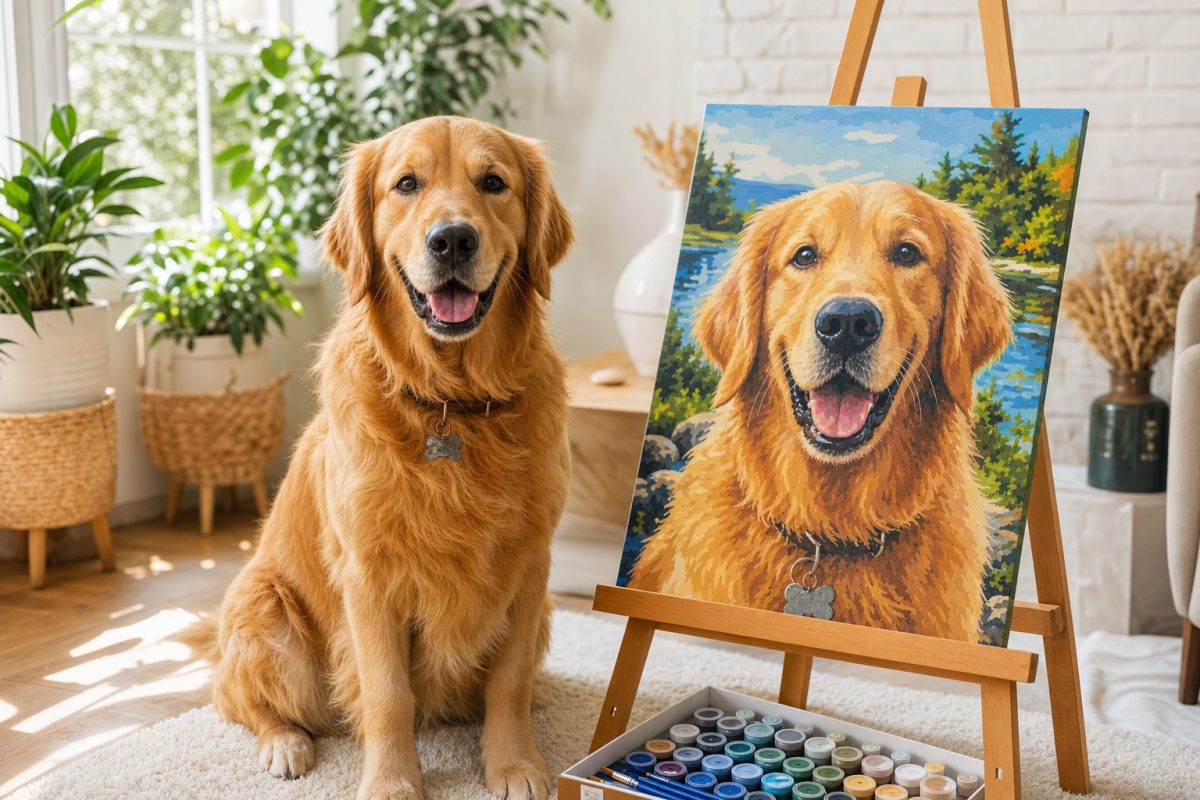
Every time you sit down, you fill in more sections. The image gets clearer. The thing you love, your dog, your wedding photo, your grandmother's garden, starts to emerge from the canvas. You can see, in a tangible and undeniable way, that the time you spent mattered. There is no streak to maintain. No notification reminding you to come back. You come back because you are halfway through your dog's face and you genuinely need to see how the eyes turn out.
BJ Fogg's research at Stanford on behavior design identified "shine," the feeling of success after completing a behavior, as the strongest predictor of habit formation. Not motivation. Not reminders. The feeling of "I did it, and it was good." Paint by numbers generates that feeling continuously, because you are never more than five minutes away from completing another section and seeing the image clarify a little more.
We hear this from customers constantly. "I meant to paint for 20 minutes and it turned into two hours." "My husband had to remind me to come to bed." "I have not watched Netflix in three weeks and I do not miss it."
That is not willpower. That is engagement. And it is the reason painting sticks when journaling and meditation and apps and that expensive rowing machine did not.
What You Actually Get Back
Let us talk about what changes when you replace an hour of scrolling with an hour of painting. Not the poetic version. The practical, measurable version.
You sleep better. This one is almost embarrassingly straightforward. Blue light from screens suppresses melatonin production. The Harvard Health Letter reported that blue light exposure before bed suppresses melatonin for about 3 hours and shifts the circadian rhythm by a comparable amount. Painting does not emit blue light. It requires warm, directional lighting that does not suppress melatonin. Multiple customers have told us unprompted that their sleep improved within the first week of painting in the evening. Not because paint has magic properties. Because they stopped staring at a screen until midnight.
You feel calmer, and it lasts. That cortisol reduction is not momentary. A 2021 meta-analysis of 37 studies on art-based interventions found that regular creative activity (2 to 3 sessions per week) was associated with reduced anxiety, improved mood, and increased feelings of self-efficacy over periods of 4 to 12 weeks. The effects were cumulative. Each session built on the last.
You have something to show for your time. This is the big one. The one that addresses that vague guilt. After an hour of scrolling, you have nothing. No memory. No artifact. No proof you were even conscious. After an hour of painting, you have visible progress on a canvas that you will eventually hang on your wall. The accumulation effect is powerful. Every session adds to something tangible that did not exist before you started.
You start conversations you would not have had. When people see your canvas, they ask about it. What is the photo? How long have you been working on it? Can I try? Painting becomes a thing in your life that generates connection instead of consuming it. Multiple customers have told us that their kit became a family activity. Kids asking to paint a section. Partners pulling up a chair. Friends who come over and end up doing three sections before they leave.
"But I Am Not Creative"
I need to address this because it is the number one objection we hear, and it stops people cold before they ever start.
Paint by numbers requires zero creativity. Zero artistic ability. Zero experience. None. If you can hold a pen and distinguish between the numbers 1 and 2, you can do this. The canvas tells you exactly where every color goes. You are not making artistic decisions. You are following a map.
That is actually part of why it works so well as a stress relief tool. Creative decision-making can itself be a source of stress. "Am I choosing the right color? Does this look right? Am I ruining it?" Those questions create performance anxiety that defeats the purpose of a relaxation hobby. Paint by numbers removes all of that. You do not have to choose the right blue. It is pot number 14. It goes in sections marked 14. Done.
The paradox is that by removing the creative pressure, paint by numbers frees you to enjoy the creative process. You get all the benefits of making art, the flow state, the cortisol reduction, the visible progress, the pride of completion, with none of the anxiety of making choices. It is structured enough to be calming but engaging enough to hold your attention for hours.
When we survey our first-time customers, 73% describe themselves as "not artistic" or "not creative." When we survey them after completing their first kit, 89% say they plan to do another. The gap between "I cannot do this" and "I love this" closes in about forty-five minutes of actual painting.
Who Is Actually Doing This
Let me give you a real picture of who is ordering these kits. Because the stereotype (retired grandmothers with too much free time) is wildly inaccurate.
Our customer base skews 65% female, 35% male. The largest age cohort is 30 to 45. This is the generation that grew up with the internet, that spends the most time on their phones, and that reports the highest levels of screen fatigue and digital burnout. They are not looking for a "craft project." They are looking for an exit from the scroll.
The second largest cohort is 45 to 60. Many of these customers describe empty-nest adjustments, career transitions, or simply the desire to "do something with my hands that is not typing." Several have told us they tried various hobbies and this is the one that stuck.
We have shipped kits to 87 countries. The youngest customer we know of was 12. The oldest was 94. The most dedicated repeat customer has completed 32 kits. The fastest completion we have ever seen was 11 hours straight (a 24-color kit, energy drinks were involved). The slowest is still in progress after 14 months. Both of those people gave us five stars.
This is not a niche hobby for artsy people. This is a mass movement of normal adults who are sick of staring at screens and found something better to do with their evenings. They just do not talk about it much, because "I spent my evening painting a picture of my dog" does not have the same social currency as "I went to the gym." But it should. Because the mental health benefits are real, the satisfaction is real, and the painting on the wall at the end is really, really real.
The Evening Reset
Here is what a typical painting evening looks like, based on patterns from thousands of customer descriptions.
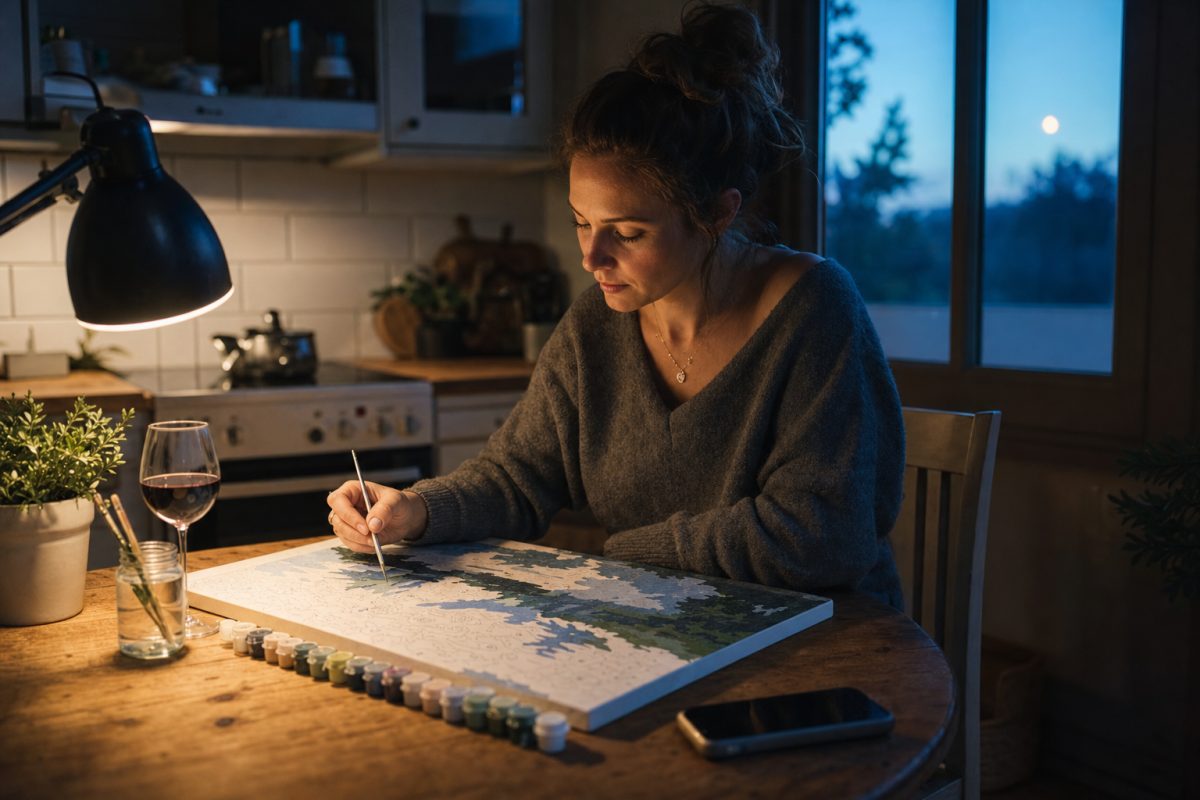
You finish dinner. Instead of reaching for your phone, you set up your canvas. It takes thirty seconds. Canvas on the table, paint pots for tonight's color, water cup, paper towel, lamp on.
You put on music or a podcast or nothing at all. You open the paint pot. You start filling in sections.
Five minutes in, you stop thinking about work. Ten minutes in, you stop thinking about your phone. Fifteen minutes in, you stop thinking about anything except the section in front of you and the way this particular shade of blue is exactly right for the sky on that day.
An hour passes. Maybe two. You close the paint pot, clean your brush, put the canvas aside. You look at what you did. There is a little more of the image than there was before. A little more of the memory, made physical.
You go to bed. You fall asleep faster than you have in weeks. Tomorrow, the canvas will be there, waiting, and you will be looking forward to it.
That is the evening reset. And once you have it, you will wonder how you ever filled that time with scrolling.
How to Start Tonight
You do not need to clear a room or buy an easel or set up a studio. You need a kitchen table, a glass of water for rinsing brushes, a paper towel, and a lamp.
Pick a photo that means something to you. Upload it. Choose your kit. When it arrives, open one paint pot, pick up the smallest brush, and fill in one section.
That is it. One section. It will take 30 seconds.
Then do the section next to it. And the one next to that.
Somewhere around the third or fourth section, the noise stops. Your phone is face-down on the counter. Your breathing has slowed. You are inside the photo, following the numbers, and the world is exactly the size of the canvas in front of you.
That is the feeling. That is what 53,000 people found. And now you know where to find it too.