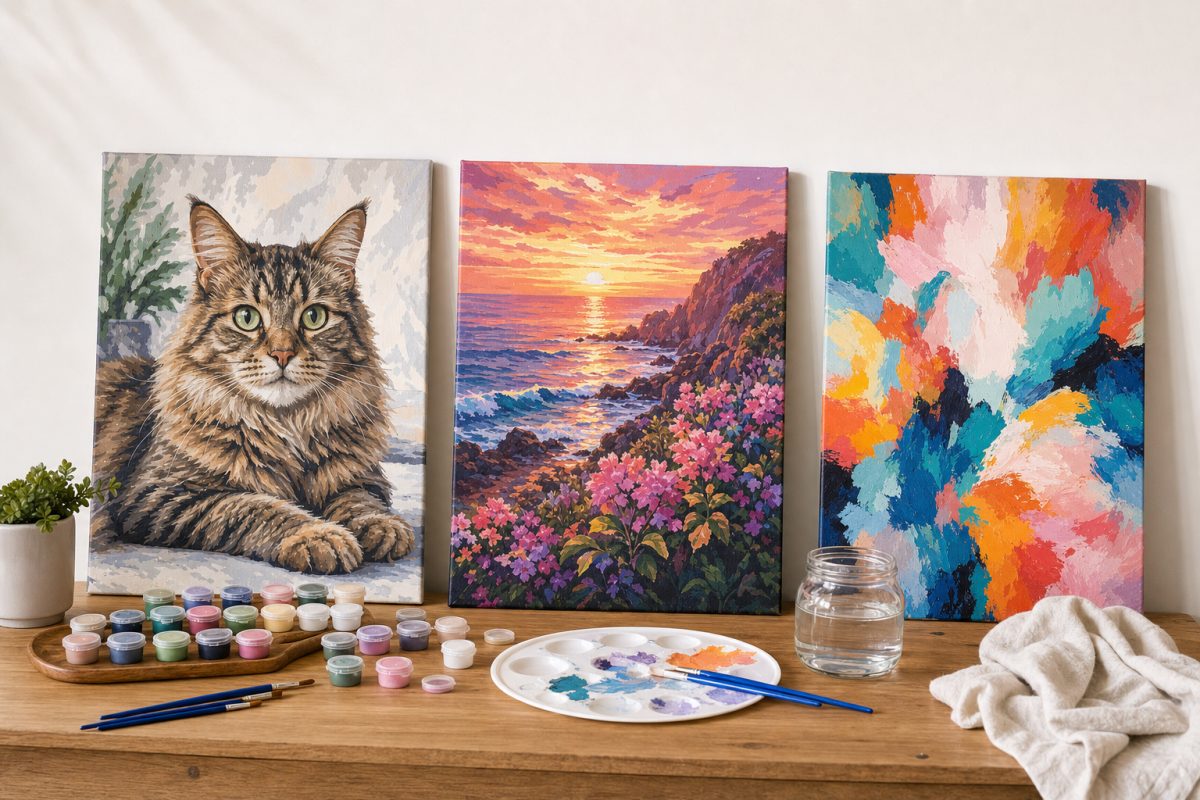
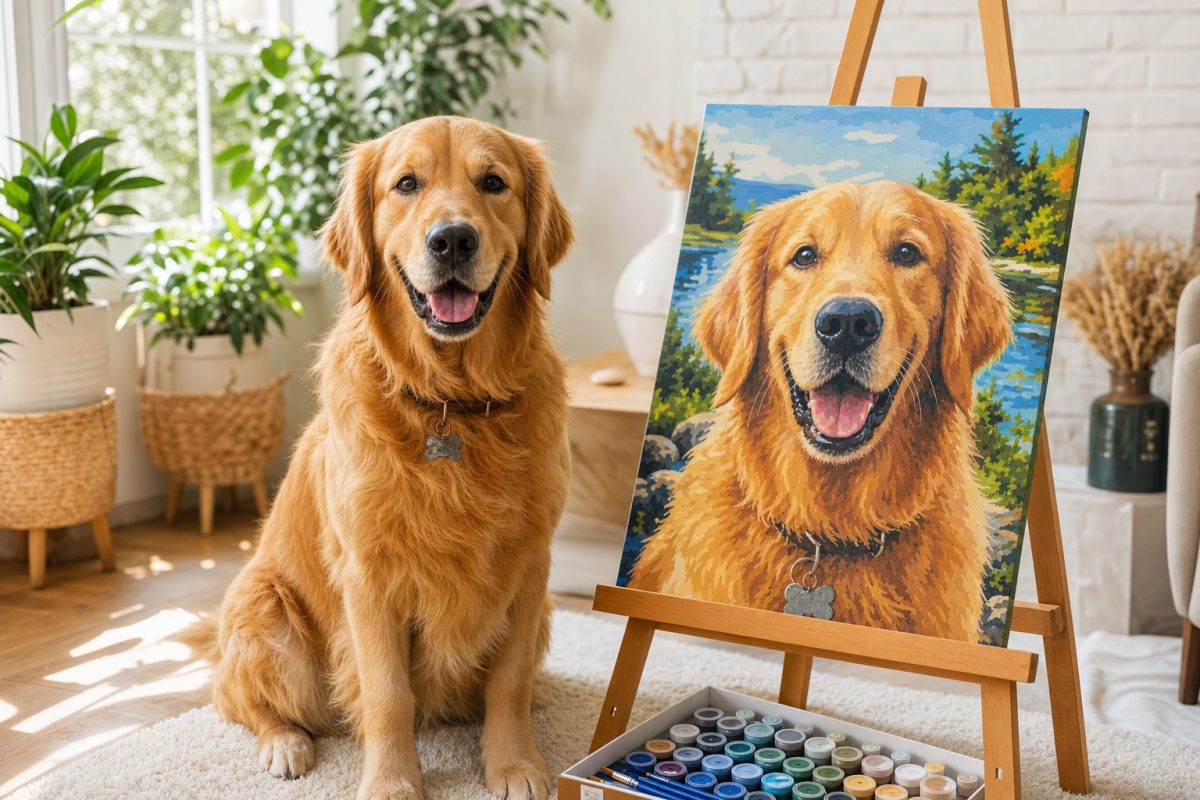
Forty percent. That is the share of our orders that are pet portraits. Dogs, cats, horses, rabbits, and one memorable iguana named Gerald.
After shipping over 21,000 pet kits, I have learned something about pet people: the photo on their phone is never just a photo. It is proof. Proof that this creature exists, that it chose them, that it makes their house a home. And turning that proof into a painting they made with their own hands? That is an entirely different level of connection.
This guide covers everything: how to pick the right photo, which settings work best for different animals, what the painting process is like, and why the finished result makes visitors stop in their tracks.
Why Pet Portraits Work So Well as Paint by Numbers
Not every photo converts equally well to a paint-by-numbers canvas. But pet photos have natural advantages that make them some of the best subjects for this medium.
Fur has incredible tonal range. A golden retriever is not one color. It is fifty shades of gold, cream, amber, and brown, shifting with every curve of muscle and fall of light. A paint by numbers kit breaks that complexity into discrete sections, and when you fill them in, the fur starts to look three-dimensional. The effect is striking. Customers regularly tell us the fur texture is their favorite part of the finished painting.
Eyes are the emotional anchor. Animal eyes in paint by numbers are where the magic lives. When you reach the eyes in your painting (usually toward the end, since they involve lighter highlights and fine detail), the entire canvas snaps into focus. It goes from "a nice painting of a dog shape" to "that is Max, and he is looking right at me." Multiple customers have told us they gasped when they finished the eyes. Not because of the technical quality. Because the painting suddenly felt alive.
The emotional connection carries you through. Every painting has a middle phase where it looks like a mess. Random blobs of color that do not resemble anything. With a generic landscape, you might lose motivation. But when you know those blobs are going to become your dog? You keep going. The love for the animal powers you through the ugly middle, and the payoff on the other side is enormous.
How to Choose the Perfect Pet Photo
This is the most important decision you will make, and it is the question we get asked most often. Here is what works, what does not, and why.
Face the camera. The best pet portraits show the animal's face clearly, looking toward the camera or slightly to the side. Front-facing and three-quarter angles produce the most recognizable results. Profile shots can work but lose some of the emotional impact because you cannot see both eyes.
Good lighting is everything. Natural light is ideal. The photo you snapped of your cat in the sunny window? Perfect. The photo of your dog in the dimly lit hallway? Harder to convert. Light creates the tonal variations that make a painting look dimensional. Without good light, the conversion algorithm has less information to work with, and the result can look flat.
Close-up beats full body. A tight crop of your pet's face and upper body produces more detail and impact than a full-body shot from across the room. When the subject fills most of the frame, there are more sections dedicated to the parts you care about (the face, the expression, the fur pattern) and fewer sections wasted on background.
Simple backgrounds win. A dog on a solid-colored couch converts beautifully. A dog in a busy park with trees, people, and other dogs behind it? The algorithm has to allocate colors to the background, which means fewer colors available for your pet. If you have a great photo with a busy background, do not worry. We can work with it. But if you have the choice, simpler is better.
Avoid heavy filters. Black and white photos, sepia filters, and heavy Instagram filters strip color information that the algorithm needs. Use the original, unfiltered photo whenever possible. The more color data in the source, the more accurate and vibrant the painting.
Color Count: What to Choose for Different Animals
Dogs with shorter, uniform fur (Labs, Beagles, Pugs): 24 colors works beautifully. The color palette is simpler, and the broader sections actually complement the smooth coat texture.
Dogs with complex fur patterns (Huskies, Australian Shepherds, Bernese Mountain Dogs): 36 colors. The additional palette captures the multi-tonal patterns and markings that make these breeds visually stunning.
Long-haired cats and dogs (Persians, Golden Retrievers, Shih Tzus): 36 or 48 colors. Long fur has incredible tonal variation as it layers and catches light at different angles. More colors means more of that texture translates to the canvas.
Black or very dark animals: 36 or 48 colors, counterintuitively. A black cat is not one shade of black. In good light, there are deep purples, dark blues, warm browns, and cool greys. More colors capture these subtle shifts and prevent the result from looking like a silhouette.
Multi-pet compositions: 36 or 48 colors. Two or more animals in one frame means more subjects competing for the color palette. A higher count ensures each animal gets enough tonal range to be individually recognizable.
The Painting Process: What to Expect
Your kit arrives. You open the box. There on the canvas is your pet, broken into hundreds of numbered sections. It looks like a complex coloring page, and it looks nothing like your photo. That is normal. Trust the numbers.
Start with the darkest colors. The deep background tones, the dark fur patches, the shadows. Your canvas will look moody and abstract for the first few sessions. This is the ugly middle, and every single painting goes through it.
Then the mid-tones go in. This is where the form starts to emerge. You will see the shape of the body, the curve of the ears, the contour of the muzzle. It starts to look like an animal, but not yet like YOUR animal.
Then the lighter colors. The highlights on the fur. The catch-light in the eyes. The pink of the nose. The tongue. This is where the painting transforms from "an animal" to "my animal," and it happens faster than you expect. One section of highlight in the eye and suddenly the painting is looking at you.
The whole process takes 8 to 20 hours depending on color count and your pace. Most people spread it over one to three weeks, painting in the evenings. Some binge a whole weekend. There is no wrong speed.
Memorial Pet Portraits
I need to talk about this because it is a significant portion of our pet orders, and the emotional weight of these kits is something we take seriously.
Many of our pet portrait customers are painting animals who have passed. A dog they had for 14 years. A cat who was with them through college, marriage, kids, and every hard thing in between. The painting is not just art. It is a way of sitting with that animal one more time.
The process of painting a memorial portrait is different from painting a living pet. Customers tell us it is slower. More deliberate. More emotional. Some cry while painting. Not in a bad way. In a "I am spending time with you again" way. The brushstrokes become a form of remembering. Every section of fur you fill in is a minute spent with that animal in a way that looking at a phone photo never achieves.
The finished painting hangs on the wall, and it is not a monument to loss. It is a celebration of the time you had together. "That is Bailey," you tell visitors. "I painted her myself." And then you tell the story, which is the story you wanted to tell all along.
We handle these orders with extra care. If you are ordering a memorial kit and want to tell us about your pet, we read every message. We are not just a paint company for these orders. We are part of the process.
The Result
Your finished pet portrait will surprise you. Not because of technical perfection. Because of emotional impact.
You spent hours inside this image. You learned every shadow on your pet's face. You discovered colors in their fur you never noticed in the photo. You reconstructed their expression, brushstroke by brushstroke. And now it exists as a physical object on your wall, made by your hands, carrying every minute of attention you poured into it.
When guests see it, they will ask. They always ask. "Is that Max?" "Did you paint that?" And you will tell them yes, and the story of the photo, and the story of the painting, and somewhere in there is the real story: this animal matters to me, and I wanted to prove it with my own hands.
That is why 40% of our orders are pet portraits. Not because the paintings are technically impressive (though they are). Because the act of painting your pet changes how you see them. And what you are left with, on the wall, in the room, every single day, is the visible proof of love, made physical.