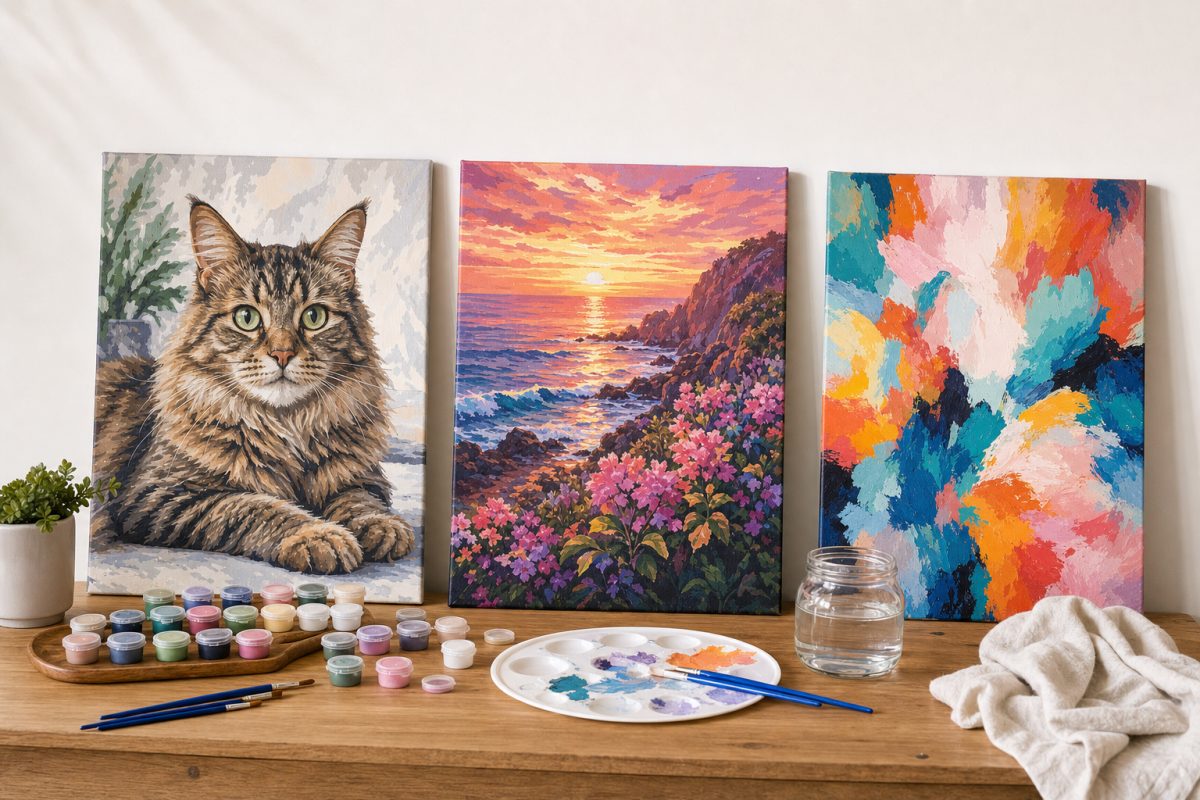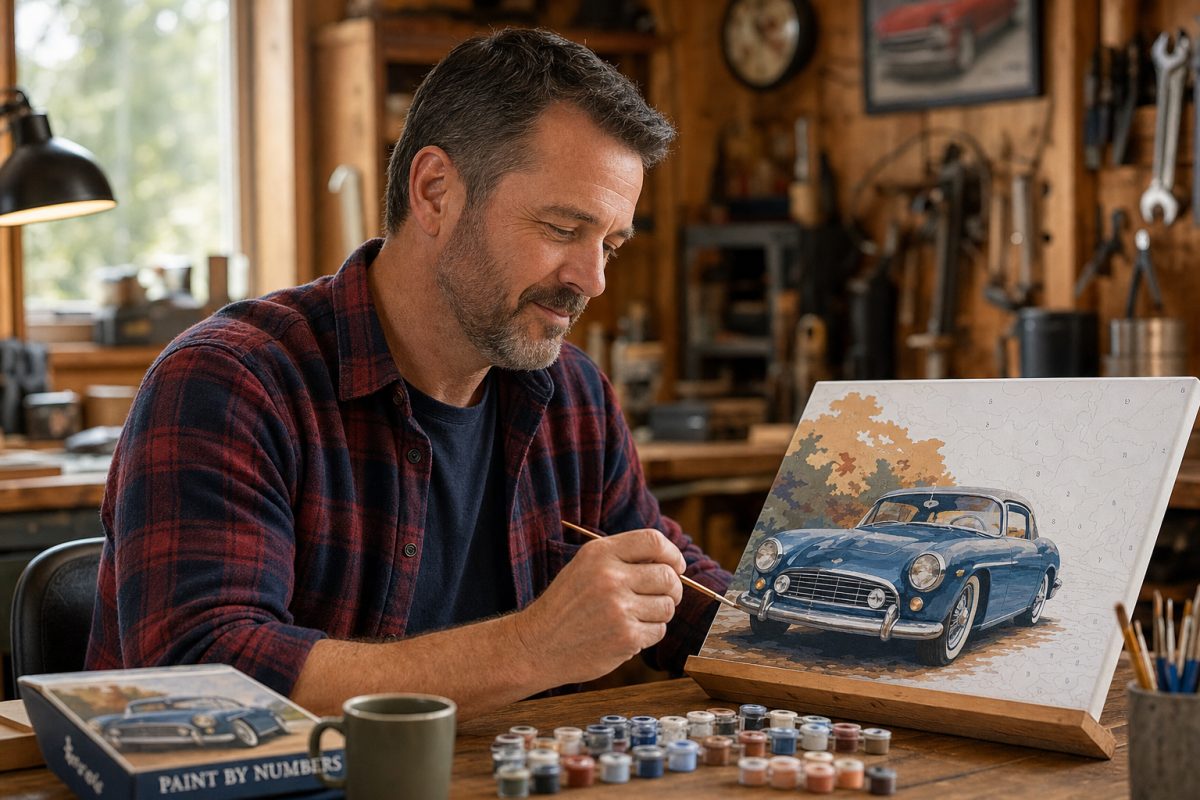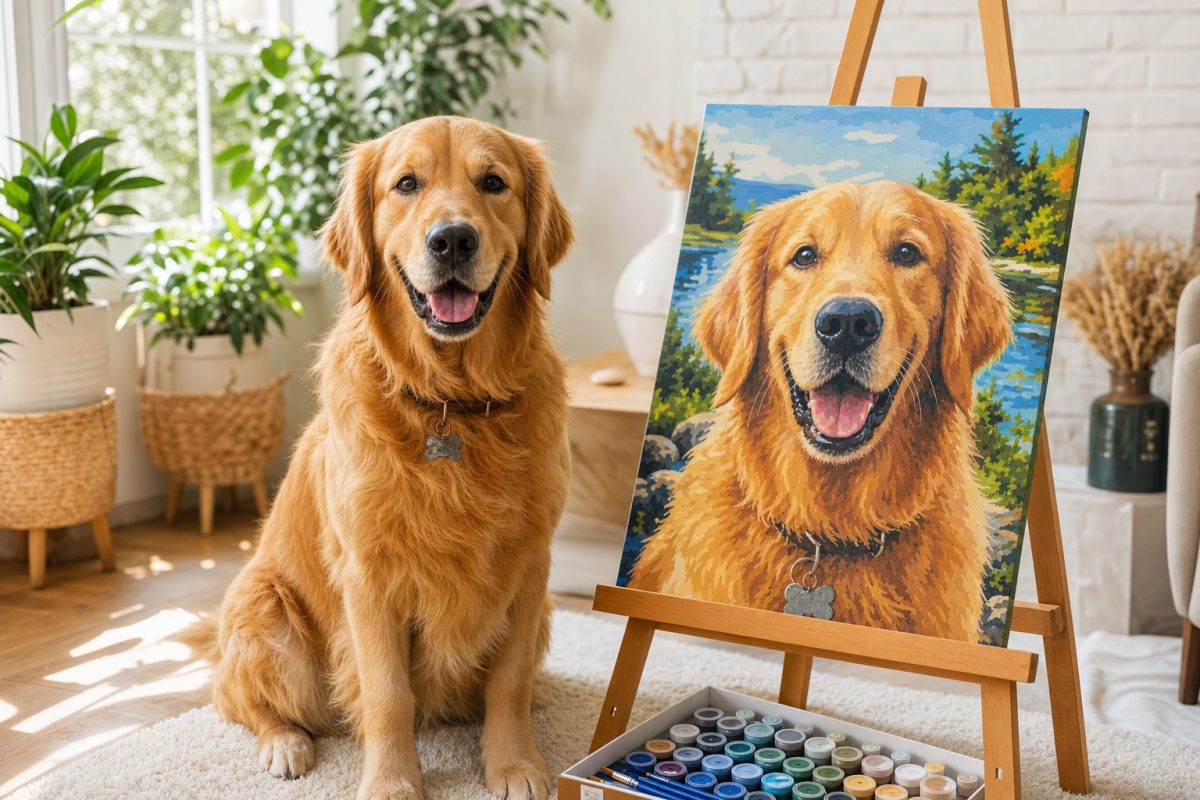
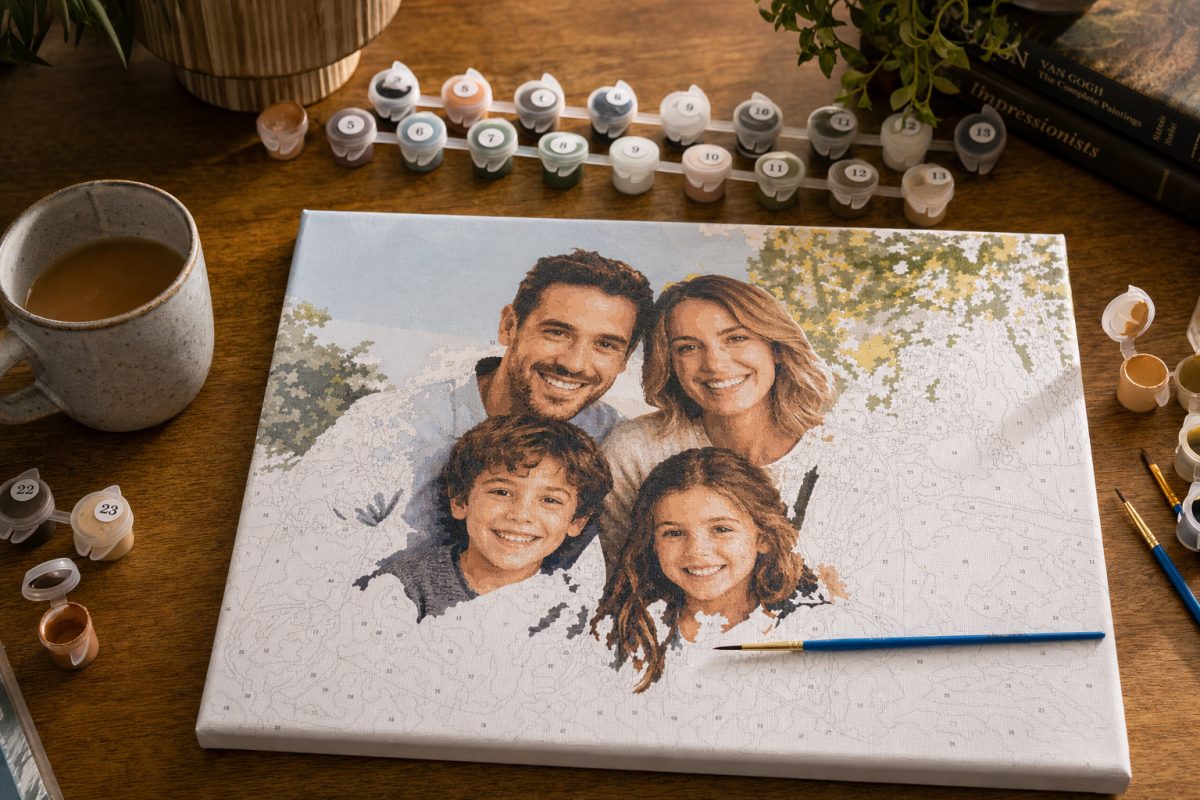
You know the photo. It has been sitting in your camera roll for months, maybe years. You scroll past it sometimes and feel something, but you never stop long enough to figure out what.
Maybe it is your dog stretched out on the couch with the afternoon sun on his fur. Maybe it is your grandmother in the kitchen, mid-laugh, holding a wooden spoon. Maybe it is a trip you took with someone you love, and the light was just right, and nobody was looking at the camera.
That photo. The one that makes your chest tight for half a second before you keep scrolling.
That is the one you should paint.
The Moment You Open the Box
It arrives in a flat package. Nothing fancy. You tear it open and there it is: your photo, broken into hundreds of tiny numbered sections on a canvas. It looks impossible. Like somebody took the thing you love and turned it into a math problem.
But then you pick up the first brush. You dip it into pot number 1. And you start filling in the shapes.
Something shifts.
You are not looking at the photo anymore. You are inside it. Every color you lay down forces you to really see what was there all along. The way the light catches your dog's ear. The exact shade of your grandmother's apron. The blue of the sky that day, which was not really blue at all, but something closer to grey with a promise in it.
There is a psychological concept called "slow looking" that museums have been experimenting with for the last decade. The idea is simple: when you force yourself to spend extended time with a single image, you begin to notice things that a quick glance completely misses. Harvard's Project Zero found that students who spent just 10 minutes with one artwork reported seeing details they were certain were not there before. Not because the details appeared. Because their brains finally slowed down enough to register them.
Paint by numbers is slow looking, but with your hands involved. You do not just stare at the photo. You reconstruct it, color by color. And in the process, you discover things about the image that surprised you.
"I thought I was just painting a picture. But I was actually sitting with a memory I had been running past for years. I cried when I finished it. Not sad tears. Just... recognition."
We hear things like this every week. And every time, it catches us off guard. Because we sell paint by numbers kits. We are not trying to be therapists. But something happens between the first brushstroke and the last one that we cannot quite explain.
The Science of Why This Feels So Good
In 2020, Drexel University ran a study that measured cortisol levels in participants before and after 45 minutes of creative activity. The results were striking: cortisol dropped significantly in 75% of participants regardless of their artistic skill level. The researchers noted that the effect was comparable to a light meditation session.
But there is something paint by numbers does that freeform art does not: it removes decision fatigue.
When you sit down to draw or paint from scratch, your brain has to make hundreds of micro-decisions. What color? What shape? Where does this line go? Am I doing this right? That constant evaluation is mentally taxing, which is why most people who try "creative hobbies" quit within a week. The creativity itself becomes a stressor.
Paint by numbers strips all of that away. The only decision you make is which section to fill in next. Every color is chosen for you. Every boundary is drawn. Your conscious mind can relax because the system handles the complexity. And when your conscious mind relaxes, something remarkable happens: you enter flow state.
Flow, as psychologist Mihaly Csikszentmihalyi defined it, is the state where your skill level and the challenge in front of you are perfectly matched. Time distorts. Self-consciousness disappears. You become the activity. Most people associate flow with elite athletes or musicians, but the research consistently shows it is more about the structure of the task than the skill of the person. A well-designed paint by numbers kit hits the flow sweet spot almost perfectly: challenging enough to hold your attention, structured enough that you never feel lost.
That is why people sit down to paint for twenty minutes and look up to find two hours have passed. It is not discipline. It is absorption.
Why This Works When Other Hobbies Did Not
You have tried journaling. It lasted four days. You downloaded a meditation app. It lasted three. You bought a puzzle. It is still in the closet. You signed up for a pottery class. Went twice.
If this sounds like you, you are not lazy and you are not broken. The problem is not your willpower. The problem is that most "relaxation hobbies" rely on intrinsic motivation to keep you coming back, and intrinsic motivation is a terrible engine when you are already exhausted.
Paint by numbers is different because it has a built-in pull mechanism: visible progress.
Every single time you sit down, the image gets a little clearer. The thing you love starts to emerge from the canvas, section by section. You can see, in a tangible and undeniable way, that the time you spent mattered. There is no level to unlock. No streak to maintain. No notification reminding you to come back. You come back because you are halfway through your dog's face and you genuinely want to see how the eyes turn out.
Research on habit formation (most notably by BJ Fogg at Stanford) shows that the single strongest predictor of whether a habit sticks is whether the person feels successful while doing it. Not after. While. Paint by numbers generates that feeling continuously, because you are never more than five minutes away from completing another section and seeing the image clarify a little more.
That is a fundamentally different experience than staring at a blank journal page.
The Part Nobody Warns You About
Here is what we do not put in the product description: you will get attached to the process.
Not to the finished painting. To the painting itself. The act of it. The two hours on a Sunday where you did not check your phone, did not think about work, did not do anything except match colors to numbers.
One of our customers told us she paints every night after her kids go to bed. "It is the only time all day that belongs to me," she said. Another told us he started painting after his wife passed away, because the silence in the house was too loud and the brushstrokes filled it with something bearable. A retired teacher from Oregon told us she has done eleven kits. "Each one is a chapter," she said. "I am writing the story of everything I love, one canvas at a time."
We are a paint by numbers company. We should not be making people cry in our DMs. But here we are.
What Your Finished Painting Actually Is
It is not art. Let us be honest about that. It is better than art.
It is proof that you sat with something you love long enough to understand it. It is a conversation you had with a memory, one brushstroke at a time. It is the thing hanging on your wall that makes guests say "Wait, you painted that?" and then you get to tell them the story behind the photo, which is the story you wanted to tell all along.
The painting is not the point. The painting is what happens while you are painting.
Think about that for a second. When was the last time you spent 10 or 15 hours with a single memory? Not scrolling through old photos. Not flipping through an album. Actually sitting with one image, learning every curve and shadow and color transition, rebuilding it with your own hands?
That is an experience most people have never had. And once you have it, you understand why so many of our customers order a second kit before they even finish the first.
The Photos People Choose (And What They Reveal)
We have shipped over 53,000 kits, and the photo choices tell a story of their own. Here is what we see most often:
Pets account for roughly 40% of all orders. Dogs lead, followed by cats, then horses. Many of these are memorial paintings. People paint pets who have passed, and the process becomes a way of sitting with that animal one more time. The number of customers who have told us "painting his face helped me grieve" is something we stopped counting because it kept making the team emotional.
Wedding and anniversary photos make up about 20%. Not always the professional studio shots. Often the candid one. The one where the veil is caught in the wind. The one taken at the reception when nobody was posing. Couples often order these as anniversary gifts, and we have had more than a few messages from people who painted their parents' or grandparents' wedding photos as milestone birthday presents.
Children and grandchildren are the third biggest category. The first day of school. The messy face after the birthday cake. The backyard sprinkler photo from last summer. Parents tell us they want to "freeze" a moment that is slipping away, and painting it gives them a version of that feeling.
Travel photos and landscapes round out the top four. That street in Lisbon. The cabin at sunset. The mountain view from the hike that almost killed you but was worth it. These are the memory paintings, the ones that transport you back to a place and time when everything felt possible.
There is no wrong photo. But the right one is the one you feel something about. The one that catches you off guard when you scroll past it.
How It Actually Works
You upload your photo. Our system converts it into a paint-by-numbers template, optimized for the number of colors you choose (24, 36, or 48). More colors means more detail and nuance. A pet portrait looks great at 24. A landscape with a complex sunset might want 48.
You pick your canvas size and whether you want a frame included. The kit ships free, worldwide. Inside the box: pre-printed canvas, numbered paint pots (every color you need, already mixed and matched to the template), and a set of brushes in three sizes.
Then you paint. There is no skill required. Truly none. If you can hold a brush and read a number, you can do this. Most people finish in 8 to 15 hours, spread over days or weeks. Some take longer. Some binge a whole weekend. Both are right.
And when you are done, you have something no one else in the world has: your memory, painted by your hand, ready to hang on your wall.
One Last Thing
The photo you are thinking of right now. The one that surfaced in your mind three paragraphs ago. Go find it. Look at it for ten seconds longer than you normally would.
Notice the details you usually skip. The light source. The background. The expression on the face that you normally just feel rather than study.
Now imagine spending the next two weeks inside that image. Learning every color. Noticing every detail you missed when you snapped it on your phone. Coming back to it every evening, picking up where you left off, watching it emerge on canvas, section by section, until one night you put the brush down and realize it is done.
That is what this is. And that is why 53,000 people and counting have chosen to do it.