Let me describe a brain you might recognize.
It does not stop. Not when you want it to. Not when you need it to. It runs through tomorrow's problems at midnight. It replays conversations from six years ago. It jumps from thought to thought like a browser with 47 open tabs, and closing one just opens two more.
You have tried meditation. You sat there, eyes closed, trying to think about nothing, and your brain treated that as an invitation to think about everything louder. You have tried journaling. Writing your thoughts down just showed you how many there are. You have tried breathing exercises, sleep stories, ASMR, white noise, walks, baths, and that expensive weighted blanket.
Some of it helps. None of it reliably works every time. Because the fundamental problem is not that your brain needs to be emptied. It is that your brain needs something specific and absorbing to focus on. Something that replaces the noise with signal.
That is where paint by numbers comes in. And I am not being cute or reductive about mental health. I am telling you what thousands of our customers with anxiety and ADHD have told us, unprompted, in their reviews and emails.
Why Your Brain Responds to This
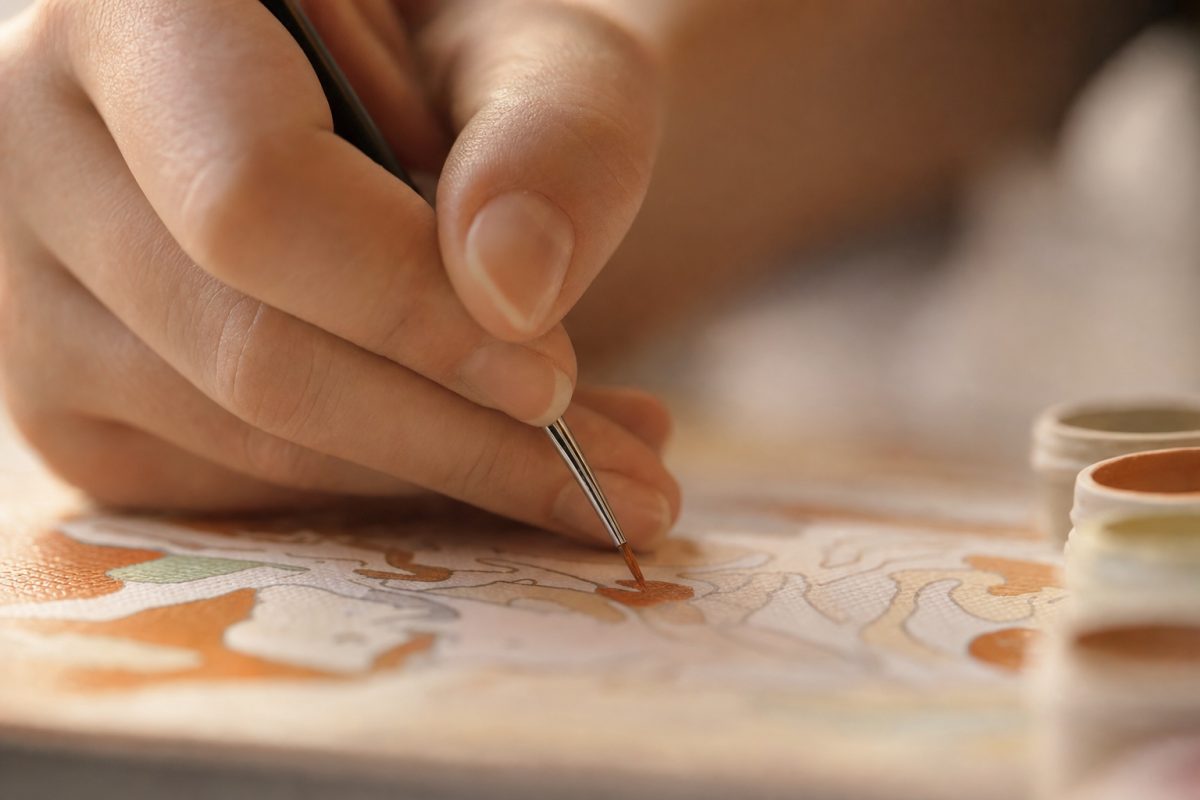
Paint by numbers provides something that neuroscientists call an "external attentional anchor." Instead of asking your brain to generate its own focus (which is exactly what it struggles with), you give it a concrete, immediate task: find section 14, dip into color 14, fill in the section. Then find the next 14. Repeat.
This is not mindfulness in the traditional sense. It is better described as directed attention. Your brain is fully occupied with a task that is:
Specific enough to require focus. You cannot paint section 14 while thinking about your tax return. The numbers are small. The brush requires precision. Your visual cortex, motor cortex, and executive function are all engaged. There is not enough bandwidth left for the anxiety loop.
Simple enough to avoid frustration. There is no creative decision-making. No "am I doing this right?" paralysis. The system tells you exactly what to do. For a brain that is already overwhelmed by decision fatigue, this removal of choice is a relief, not a limitation.
Rewarding enough to sustain attention. Every completed section is visible progress. The image gets a little clearer. The painting gets a little closer to done. For ADHD brains that struggle with delayed gratification and need frequent dopamine hits to maintain engagement, this continuous micro-reward loop is perfectly calibrated. You are never more than two minutes away from the small satisfaction of finishing a section.
Dr. Ned Hallowell, a psychiatrist and one of the leading experts on ADHD, has written extensively about the concept of "flow" as a therapeutic tool for ADHD brains. Flow state, where your skill level matches the challenge and time seems to distort, is one of the few states where an ADHD brain is both calm and focused simultaneously. Paint by numbers hits the flow sweet spot almost perfectly: challenging enough to hold attention, structured enough to prevent overwhelm.
What Our Customers Tell Us
We did not set out to make a product for people with anxiety or ADHD. We found out we had when the emails started coming in. Here are the patterns we see, anonymized but representative of thousands of messages.
"It is the only thing that shuts my brain off." We hear this exact phrase, or close variations, multiple times per week. Not "it helps" or "it is nice." It shuts my brain off. For people who live with constant mental noise, that language is not casual. It is describing a rare experience of genuine quiet.
"I can actually sit still." From ADHD customers especially. The restlessness that drives them to check their phone, change tasks, get up, sit down, fidget... it stops when they paint. Because their hands are busy, their body is engaged, and their brain has exactly enough stimulation to stay put. Several customers have described painting as "the first time I have been voluntarily still in years."
"My anxiety cannot get traction." Anxiety needs empty space to spiral. It needs the gap between activities where your mind starts playing "what if." Paint by numbers fills that gap completely. There is no room for catastrophic thinking when you are focused on whether this section is a 23 or a 28. The anxious thoughts do not disappear permanently, but for the duration of the painting session, they lose their grip.
"I sleep better on nights I paint." This one has a straightforward explanation. Painting replaces screen time (blue light, doom-scrolling, cortisol-spiking content) with a calm, warm-lit activity that naturally winds the nervous system down. Several customers describe painting as their pre-bed ritual, replacing the phone scroll that used to keep them wired until midnight.
The Science (Brief, Because You Are Here for the Practical Part)
The cortisol study keeps coming up because it is the most cited and most relevant: Drexel University, 2020, published in Art Therapy. 45 minutes of creative activity reduced cortisol levels in 75% of participants regardless of artistic skill or experience. The reduction was comparable to a light meditation session.
But there are two additional findings worth knowing:
A 2019 study in The Arts in Psychotherapy found that structured art activities (where the framework is provided, like paint by numbers) produced greater anxiety reduction than unstructured art in participants with generalized anxiety disorder. The researchers hypothesized that the structure removes the decision-making burden that can itself trigger anxiety in people who are already overwhelmed.
A 2021 review in PLOS ONE analyzing 37 studies on creative activities and mental health found that regular engagement (2 to 3 sessions per week) was associated with reduced anxiety, improved mood, and increased feelings of self-efficacy over 4 to 12 week periods. The effects were cumulative and dose-dependent: more sessions produced more improvement, with no ceiling effect observed within the study timeframes.
Translation: doing this regularly actually makes a measurable difference. Not as a replacement for professional treatment if you need it. As a complement. A tool in the toolkit that happens to feel like a hobby.
Why This Works When Other "Calm Down" Hobbies Did Not
If you have anxiety or ADHD, you have probably tried and abandoned several hobbies that were supposed to help. Here is why paint by numbers sticks when others did not.
Meditation: asks you to focus on nothing. An anxious brain treats emptiness as an invitation to worry. An ADHD brain treats it as unbearable boredom. Paint by numbers gives you something specific to focus on. The quiet comes as a side effect of the focus, not as the goal.
Journaling: asks you to articulate your thoughts. For some people, putting anxious thoughts on paper helps. For others, it amplifies them. "Now I can see how much I am worrying" is not always therapeutic. Painting bypasses verbalization entirely. You are not processing thoughts. You are replacing them.
Puzzles: close to paint by numbers in structure, but without the creative satisfaction. Finishing a puzzle means you reassembled someone else's picture. Finishing a painting means you made something. That distinction matters for self-efficacy, which is often low in people with chronic anxiety.
Adult coloring books: the closest analog, and many people start there. But coloring books have a decision-making component (which color goes where?) that paint by numbers removes. They also produce flat, two-dimensional results. A finished paint by numbers canvas looks like art. A finished coloring page looks like a finished coloring page. The pride gap is significant.
Exercise: genuinely effective for anxiety and ADHD, but requires activation energy that is often impossible when you are already depleted. Opening a paint kit requires approximately five seconds of effort: sit down, open pot, pick up brush. The barrier to entry is almost zero, which matters enormously when your executive function is running on fumes.
How to Start If Your Brain Is Already Saying "But..."
If you have anxiety, your brain is probably already listing reasons this will not work for you. If you have ADHD, your brain is excited but also worried it will lose interest after one session. Both of those reactions are normal and neither of them predicts what will actually happen.
Here is the low-pressure way to try:
Start with 24 colors. Larger sections, less visual complexity, faster visible progress. This is important for ADHD brains that need the reward loop to kick in quickly. You will see results within the first 20 minutes, and that early gratification is what hooks the attention for the longer haul.
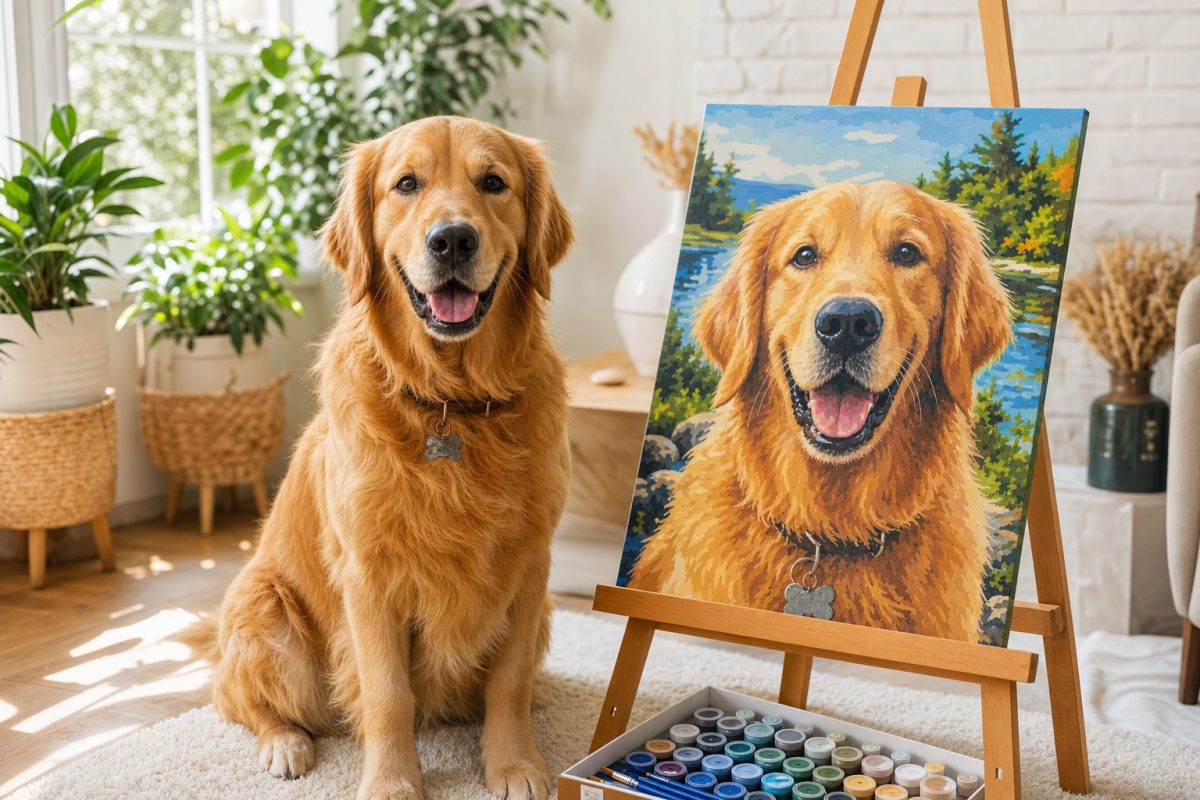
Pick a photo you love. Not a random image. Your dog. Your favorite place. Something emotionally meaningful. The emotional connection provides additional motivation that sustains engagement when novelty wears off. For ADHD brains, emotional connection is one of the most reliable engagement drivers.
No time goals. Do not decide you will paint for an hour. Paint one section. If that leads to two, great. If it leads to twenty, you are in flow. If it leads to one and you stop, that is also fine. The canvas will be there tomorrow. The pressure of "I should do more" is an anxiety trigger, not a motivation tool.
Paint at night. Replace the last scroll session before bed. The warm lamp, the quiet focus, the physical activity of the brush. Your nervous system will do the rest. Most of our anxiety-focused customers discovered their painting habit by accident at 10pm on a weeknight.
A Note About Professional Help
Paint by numbers is not therapy. It is not medication. It is not a substitute for professional mental health care. If you are struggling with anxiety or ADHD that impacts your daily functioning, please talk to a professional.
What it is: one genuinely effective tool for managing the daily noise. A way to give your brain something specific to do when the alternative is spiraling. A quiet hour in the evening where the tabs finally, finally close.
53,000 customers use our kits. Many of them came to us because they wanted to paint a photo of their dog. A surprising number of them stayed because painting turned out to be the anxiety management tool they did not know they were looking for.
If that sounds like something worth trying, start with the photo that calms you when you look at it. That one. Paint it. And see what happens in the quiet that follows.